
How Simple Coffee Shop Cleaning Routines Protect Quality Across Your Team
Coffee Shop Staff Training: Simple Cleaning Routines for Consistent Quality
Independent coffee shops don’t win by doing more. They win when every barista does the right things consistently every day, on every shift.
Quality is the differentiator. Customers come back because the coffee tastes the way they remember it. But behind that consistency is a reality every owner knows well: lean teams, constant motion, and everyone wearing multiple hats.
Coffee Shop Cleaning for Small Teams: Reducing Procedural Variance
In independent shops, there’s rarely a single role per person. Baristas open, close, dial in, prep, clean, train, and troubleshoot, sometimes all in the same shift. That reality shapes which systems succeed and which quietly break down.
When cleaning procedures are too long, too technical, or too easy to postpone, variance creeps in. One shift may complete the process thoroughly, another may shorten a step, while another may push it to “later.” No one is cutting corners on purpose. They’re trying to make a complicated system work with the time and tools available to them.
NowBrew was built with that reality in mind: simplified cleaning procedures that support small teams instead of asking them to compensate for complexity. It makes it easier for teams to complete cleaning when it should happen, not when there’s finally time.
Training New Baristas on Coffee Equipment Cleaning: What Actually Works
Every independent operator has lived this moment: a new hire is trained quickly, shown the basics, handed the close checklist, and trusted to figure it out. It is the classic “sink or swim” approach that often leads to burnout and turnover.
The problem is that long or technical cleaning routines don’t survive onboarding. They’re the first thing to drift because they’re hard to remember, hard to verify, and easy to delay. Onboarding success is about design, not motivation.
Simple, repeatable steps reduce interpretation and create fewer decision points. They make it easier for new team members to execute the same routine as experienced team members without supervision or second-guessing.
How Skipped Coffee Equipment Cleaning Affects Espresso Quality Over Time
Most cleaning gaps don’t happen because someone skips cleaning entirely. They happen because a routine feels optional in the moment.
“It’ll be fine tonight.”
“I’ll do it in the morning.”
“We’re slammed—this can wait.”
That delay is exactly when oils, proteins, and minerals start settling into internal machine parts and quietly change how equipment behaves. Flow changes, flavor shifts, and fading consistency aren’t immediate failures; they are subtle drifts. By the time anyone names the problem, it’s already been compounding for weeks.
Coffee Shop Quality Consistency: Systems Over Individual Performance
Independent shops differentiate through quality, but quality doesn’t come from one exceptional barista. It comes from repeatable output across the entire team.
Customers don’t plan their visits around who’s on bar. They expect the same cup whether it’s the owner, the lead barista, or someone three weeks into the job. Clean equipment is what makes that possible. When internal components are free of residue, machines behave predictably, recipes hold, and training sticks.
Proper cleaning is what levels the field between baristas, allowing skill and care to shine instead of compensating for inconsistent equipment behavior.
Simple Coffee Cleaning Procedures That Staff Actually Follow
Simple doesn’t mean cutting corners; it means designing routines that survive real shifts, real people, and real pressure.
There’s a misconception that higher standards require more complexity. In reality, the opposite is often true, especially in small teams.
Standards are protected when routines:
- Fit naturally into opening and closing
- Don’t require special judgment calls
- Can be performed the same way by anyone
When cleaning procedures are straightforward and safe, they get done consistently. When they’re consistent, equipment stays stable. When equipment stays stable, quality becomes predictable. When quality is predictable, your customers return/your revenue increases. That’s not a shortcut. That’s good system design.
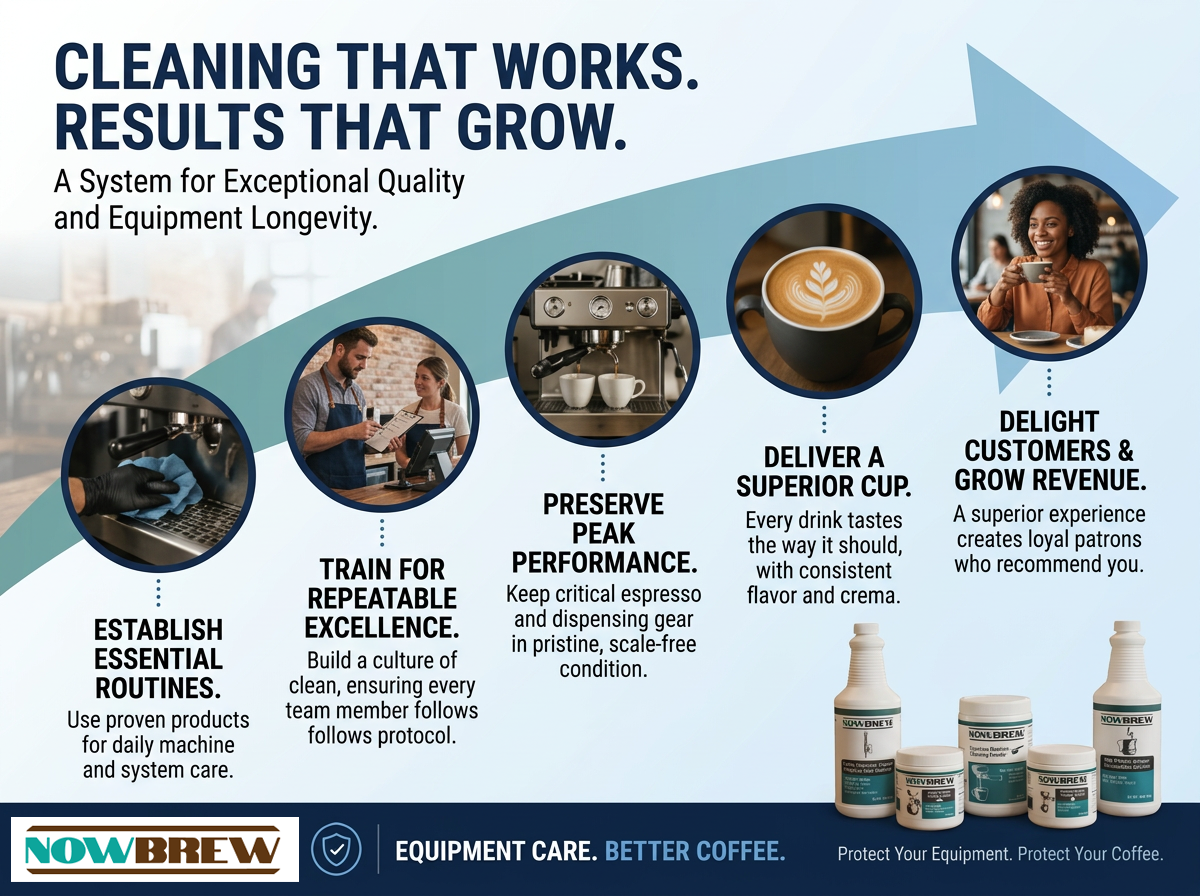
Coffee Equipment Cleaning That Requires Minimal Training
Owners often train around complex tools, adding explanations, reminders, and workarounds. That approach works temporarily, but it puts the burden on people instead of the process.
NowBrew eliminates that burden because the best training tool is a process that doesn’t need constant reinforcement. With NowBrew, the routine is designed to be easy to teach because it’s easy to do.
How Coffee Equipment Cleaning Impacts Customer Experience
Customers may not articulate it, but they sense consistency immediately. And when equipment is cleaned consistently, quality becomes the default instead of something you fight to maintain.
That’s why independent shops that prioritize simple, repeatable maintenance routines are better positioned to compete—not by working harder, but by letting their systems support their standards. Cleaning isn’t separate from those goals. It’s one of the quiet systems that makes them achievable.
If you’re thinking about how your cleaning routine supports your team—and the quality your shop is known for—let’s talk about what you’re working with.
Frequently Asked Questions About Coffee Shop Cleaning Routines and Staff Training
Q: How do you train baristas on coffee equipment cleaning effectively?
A: The most effective training uses simple, repeatable procedures with minimal decision points. Clear steps that fit naturally into opening and closing routines are easier to teach, faster to learn, and more consistently executed—especially important for new hires who need to perform cleaning without constant supervision.
Q: What happens when coffee equipment cleaning gets skipped or delayed?
A: Oils, proteins, and mineral deposits immediately begin settling into group heads, valves, and internal pathways. The impact isn’t sudden equipment failure—it’s gradual performance drift. Flow changes, flavor shifts, and extraction becomes inconsistent. By the time the problem is identified, buildup has been compounding for weeks.
Q: What makes a coffee cleaning routine “simple” for staff?
A: Simple routines have few steps, require no special judgment calls about when or how to use products, fit naturally into existing opening/closing workflows, and can be performed identically by anyone on staff. Safety without special PPE requirements also eliminates training complexity and handling concerns.
Q: How does coffee equipment cleaning affect staff retention and training costs?
A: Complex, hazardous, or time-consuming cleaning procedures create frustration, slow onboarding, and require constant retraining. Simple, safe cleaning routines reduce training time, lower the barrier for new hires, and eliminate a common source of staff stress—making positions easier to fill and people more likely to stay.
Q: Can cleaning procedures really impact customer experience?
A: Yes. Inconsistent cleaning leads to equipment performance drift, which causes recipe inconsistency that customers immediately taste. When one visit tastes perfect and the next is “off,” customers notice—even if they can’t articulate why. Consistent cleaning creates the consistent flavor that builds customer loyalty.
Q: How do you ensure all staff members clean coffee equipment the same way?
A: Design procedures that leave minimal room for interpretation. When routines are straightforward, safe without special precautions, and require the same steps every time, variance decreases naturally. Training becomes faster because there’s less to remember and fewer opportunities for individual approaches to diverge from the standard.
Subscribe for Promotions & New Product Updates
FREE GUIDE FOR COFFEE SHOPS
Build More Consistency
Into Every Cup
Simple cleaning routines and practical systems to help protect coffee quality every day.